Every serious footballer eventually runs into the same question: How do I improve my touch faster than everyone else?
Team training is important, but the truth is that most technical improvement happens outside structured sessions. The players who develop elite ball control spend thousands of extra touches working alone, refining coordination, sharpening weak-foot ability, and training their nervous system to control the ball instinctively.
That’s where tools like the Sense Ball Soccer Trainer come into the conversation.
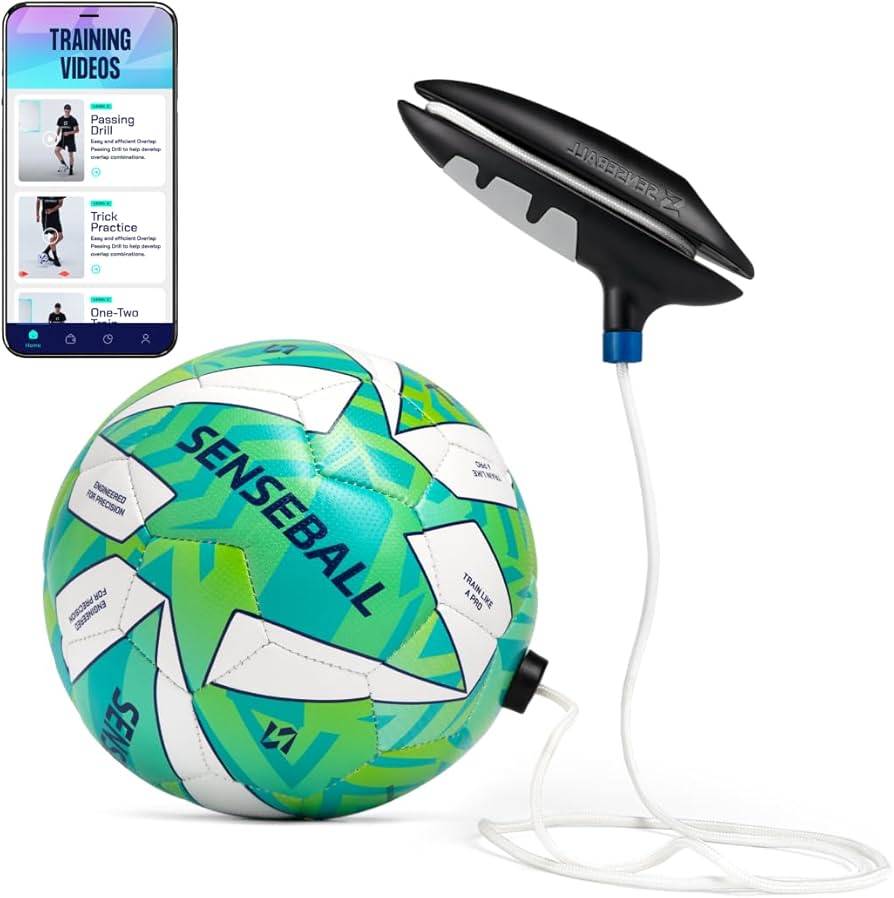
You might have seen clips of it online, a soccer ball attached to a cord and belt that rebounds automatically. At first glance it can look almost too simple. But when used properly, it becomes a surprisingly effective way to build two-footed coordination, rhythm, and touch consistency.
In this review, we’ll break down exactly what the SenseBall is, how it works, and whether it’s actually worth adding to your training routine.
What the SenseBall Is and How It Works
The basic idea behind the SenseBall Soccer Trainer is straightforward.
The ball is attached to an adjustable elastic cord that connects to a waist belt. When you strike the ball, whether with the inside, outside, laces, or sole, it rebounds back toward you. That rebound forces you to react quickly and continue the sequence.
Instead of chasing the ball after every touch, the system keeps the ball within your immediate control zone.
Looking to improve your touch? Try this.
The result is a continuous rhythm of touches. And rhythm matters more than many players realize.
Technical mastery is not just about the occasional perfect touch. It is about the brain building a reliable motor pattern through repetition. When you can perform hundreds of clean touches in a few minutes, your nervous system adapts quickly.
This is why the SenseBall is often used in short, focused training blocks, 10 to 20 minutes at a time, where players can accumulate hundreds or even thousands of touches.
And it’s a lot less expensive than other tools to improve your first touch.
Over time, that repetition sharpens:
- foot-eye coordination
- weak-foot confidence
- first-touch reactions
- balance while controlling the ball
It’s simple. But simplicity can be powerful when applied correctly.
Why Two-Footed Control Matters for Elite Players
If you watch high-level players closely, one pattern becomes obvious.
The best players in the world rarely hesitate because of their weak foot.
They might still have a dominant side, but they can comfortably control, pass, and redirect the ball with either foot. That ability unlocks more options in tight spaces.
Two-footed players can:
- receive passes under pressure from any angle
- switch direction faster
- escape defenders more easily
- play quicker one-touch combinations
In modern football, speed of decision-making is everything. And your technical range directly affects that speed.
If you need an extra touch to shift the ball to your strong foot, defenders close the space. The moment is gone.
Tools like the SenseBall Soccer Trainer specifically target this limitation by forcing players to alternate touches rapidly between both feet.
The ball rebounds unpredictably enough that you cannot rely on one side. Your brain begins adapting to process touches on either foot automatically.
Over time, that small change compounds into something significant.
Your game becomes more fluid.
How Academy Players Use SenseBall Training
Many players assume the SenseBall is mostly for younger kids learning coordination. That’s not quite accurate.
In reality, the training method behind the SenseBall Soccer Trainer is rooted in neuromotor training principles. It focuses on building the brain’s ability to coordinate movement patterns through repetition.
Academy-level players typically use it in three ways.
First, pre-training activation.
Five to ten minutes before training can wake up the feet and sharpen coordination. Instead of starting a session cold, players enter the field already feeling comfortable on the ball.
Second, technical repetition sessions.
Players might perform hundreds of alternating touches while focusing on balance, posture, and body control.
Third, weak-foot development.
By forcing alternating touches, the system helps reduce reliance on a single foot. Over time, that translates into more confident play during matches.
The key is not just mindless repetition. Players should stay mentally engaged, focusing on clean contact and controlled rhythm.
Five Drills Players Can Do Every Day
The SenseBall becomes far more valuable when used with structure. Here are five drills that build real technical improvement.
1. Alternating Inside Touch Rhythm
Strike the ball using the inside of each foot, alternating left and right continuously.
Focus on:
- consistent rhythm
- balanced posture
- soft first contact
Start slowly. As control improves, increase the speed.
2. Inside-Outside Combination
Touch the ball with the inside of the foot, then immediately with the outside of the same foot before the rebound.
Alternate feet every repetition.
This drill builds close control and quick foot adjustments.
3. One-Foot Weak Side Training
Perform repeated touches using only your weaker foot.
This forces your brain to adapt to unfamiliar coordination patterns. Even five minutes a day can produce noticeable improvement.
4. One-Touch Passing Rhythm
Strike the ball firmly so it rebounds quickly, then play the next touch immediately.
This drill trains the timing required for quick passing combinations.
5. Reaction Control
Strike the ball slightly off-center to create unpredictable rebounds.
React and control the next touch as quickly as possible.
This simulates the chaotic ball movements you often face during matches.
Product Specs
The SenseBall Soccer Trainer is intentionally simple in its design, but several features make it effective.
Ball Construction
How To Play Soccer in Europe Here's How We Did It..
- Durable synthetic soccer ball
- Designed for repeated rebound impact
- Balanced weight for consistent response
Elastic Rebound Cord
- High-resistance elastic cord
- Allows quick rebound while maintaining control range
- Adjustable length for different player heights
Waist Belt System
- Adjustable belt that fits youth and adult players
- Lightweight and comfortable during movement
Training Environment
- Can be used indoors or outdoors
- Requires minimal space compared to traditional ball drills
Portability
- Compact design makes it easy to transport
- Useful for home training, school gyms, or small fields
The simplicity of the system is part of its appeal. There are no batteries, sensors, or complex setup requirements. Players can start training immediately.
Pricing and Value
The SenseBall Soccer Trainer typically sells for roughly $60 to $100 depending on the version.
Compared to many modern soccer training tools, some of which cost several hundred or even thousands of dollars, it sits in a relatively accessible price range.
The value largely depends on how consistently the player uses it.
For players who incorporate it into a daily technical routine, the cost becomes easy to justify. A few minutes each day can accumulate thousands of extra touches every week.
Parents and coaches should view it not as a replacement for normal training, but as a touch multiplier.
It compresses repetition into a smaller space and shorter time frame.
Who Should and Shouldn’t Buy It
The SenseBall Soccer Trainer is best suited for players who are serious about improving their technical ability.
It’s particularly useful for:
- youth players developing coordination
- academy players working on weak-foot control
- athletes who want extra touches outside of team training
- coaches running small technical sessions
However, it may not be ideal for players who prefer dynamic movement drills. Since most SenseBall training happens in place, it does not fully replicate game movement patterns.
Think of it as a technical sharpening tool, not a complete training system.
Should You Buy A Senseball?
The SenseBall Soccer Trainer doesn’t rely on flashy technology or complex analytics.
Instead, it focuses on something much simpler, repetition and coordination.
And those two factors still sit at the foundation of elite technical development.
For players who are disciplined enough to use it consistently, even for just a few minutes each day, it can become a valuable part of their training routine.
If you’re curious about how it might fit into your own development, it’s worth taking a closer look and experimenting with a few drills. Even a short trial period can reveal whether the training rhythm works for you.
For players chasing the highest levels of the game, every additional touch matters.
Click here to read more about the Senseball.
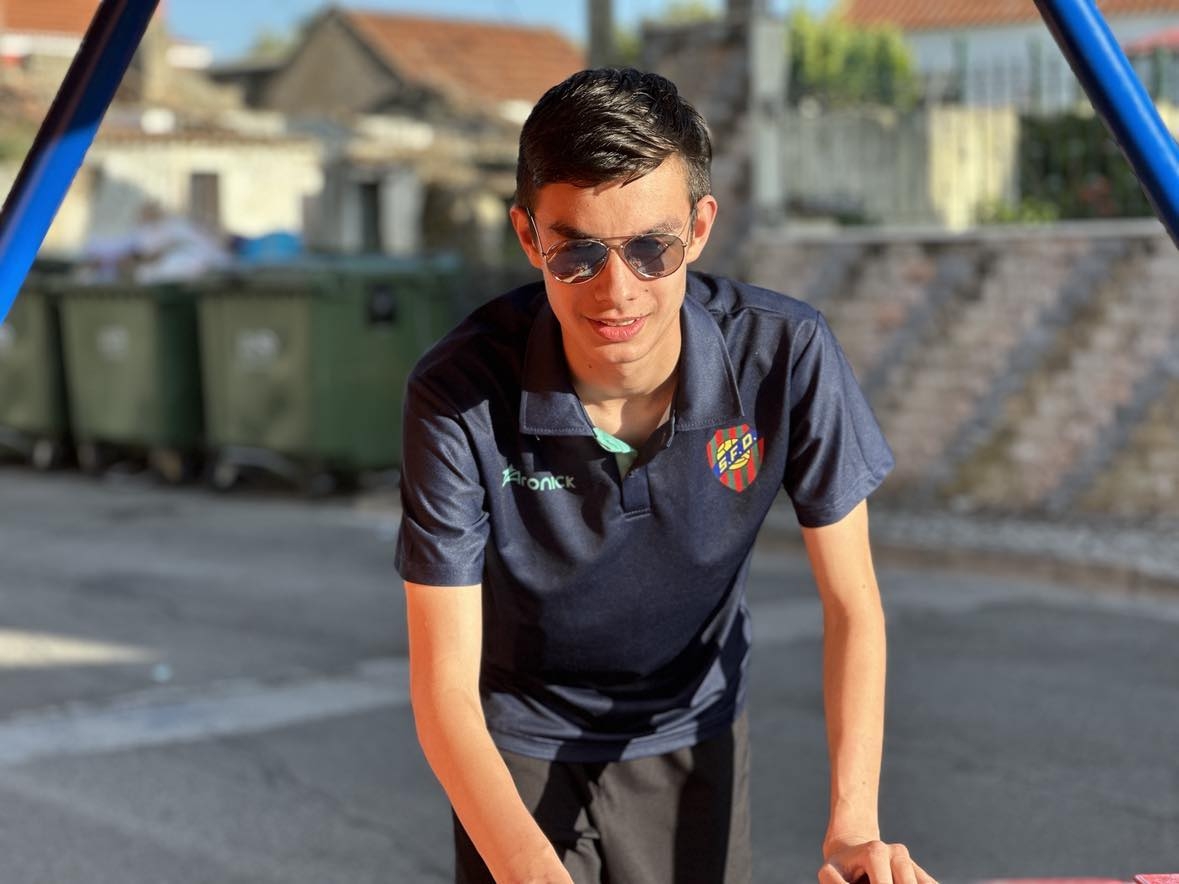
Jack was the CPL’s youngest reporter. Check out his incredibly inspiring story on CBC Sports:
Subscribe to my YouTube Channel, JackMurrayTV
Follow my journey on TikTok
I am now playing soccer at the U18 level in the First Division in Portugal.
I create Notion templates to help you become more productive!
Check out our directory of football training gear.
I just created a free leadership app for teens.